Showing posts with label getting published. Show all posts

Thursday, May 26, 2011

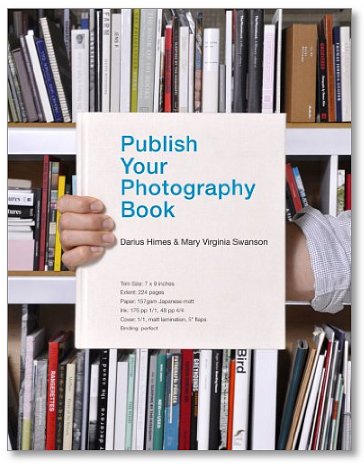
Review of "Publish Your Photography Book": pretty, disappointing

 Since I have become very interested in publishing, I couldn't wait for this book to come out. A how-to guide from industry insiders that promises to "demystify the process of producing and publishing a book of photographs"? Yes, please.  And published by Princeton Architectural Press?  I couldn't wait. And then I had to because the publishing date kept getting pushed back (there's a lesson in publishing right there—and a typical scenario for all things photo book). Well, I finally got my copy and read through the whole thing in one sitting. My conclusion in two words: pretty. disappointing.
Nice things first. The book is beautifully designed and printed. The paper is a joy to touch. The use of white space is refined. The imagery is well chosen. Even the inner inner flaps of the book are lovely. The whole thing could be filled with lorem ipsum and I would still leaf through it with pleasure.

I could be snotty and say "and it may as well have been," but that would be unfair. The content isn't bad, but it just isn't satisfying. It tries to do too much and ends up doing too little.

The book is divided into six sections:
1. The Photography Book Phenomenon
This section reads like a seminar intro. Something to make you excited to have spent your money. This is the golden age of photography, etc. etc. Preaching to the choir. Nothing particularly revelatory or insightful, but it earns the spirit stick for pep.

2. The Nuts and Bolts of Publishing
Promising. A longer chapter that promises to get down to the nitty-gritty. The chapter is subdivided into sections about "evaluating and refining your concept, "Behind the Editorial Door: Understanding How Publishers Work," "Submissions and the Path toward Publication" and so on. Those sections are each subdivided and then sprinkled throughout we have a recurring "Industry Voices" segment where the experts give insight and advice. As an outline, it all makes perfect sense and it sound like exactly the kind of information I want. Sadly, it reads like an outline. Or rather, it's like reading a PowerPoint document of a lecture you wish you could have heard in person. You can't help but feel that the authors (Himes and Swanson) have a wealth of knowledge that has been edited down to smithereens. In the "Behind the Editorial Door" section, for example, the "players" are each introduced —sometimes in a little as three sentences—and then we never get to see them play. Six (yes, Pirandello fans, there really are six!) characters in search of a plot.

3. The Making of Your Book
More subdivisions and even fewer pages. Sections include "Editorial Content," Design Considerations" and "Production Details," each with corresponding "Industry Voices." Once again, actual content is sparse. see also: scanty. meager. suitable for a quick blog post, but not for a $30 book. I expect more from Princeton Architectural Press. Bill Jay and David Hurn's On Being a Photographer has far more specific, usable advice than this new publication.

4. The Marketing of Your Book
Same story. PowerPoint notes for a talk we don't get to hear.

5. Case Studies
My favorite part of the book. In fact, if somebody could please publish a book with nothing but case studies it would be a hit. I ate this part up. I reread it. I love hearing the real stories behind a publication. My only regret is that most of studies are woefully short. They are presented in interview format and they made me feel like the interviewer was walked into a room by a PR rep and told "You have six and half minutes. Have a great interview" (see the Uma Thurman Schweppes ad that is currently playing before all movies in French theaters).

6. Resources, Appendices, and Worksheets
Alec Soth's links page on the Little Brown Mushroom Blog is just one great example of how much useful information is already online. I would have liked this book to delve a bit more and find resources that photographers wanting to break into publishing could actually have a shot at using.

In its worst moments, the book comes across as disingenuous—like a seminar about how you, too,  can become a millionaire—or in this case, John Gossage. Some of the "Industry Voices" (e.g. Andrea Danese of Abrams) can barely conceal the fact that the reader of Publish Your Photobook is almost by definition someone that will not be launched into the world of art books via any publishing house of note. That's not to say that you won't be the next success story, but I would rather read a book that keeps it real. I would like to see:
  • real numbers. Let's have some case studies that show how much a project cost from start to finish. Sébastien Girard's self-published editions of 500 would be a perfect case study for would-be self-publishers, for example.
  • real stats. Why not be real and survey some of the publishing houses given in the appendices. How many books did they put out last year, and of those, how many were of new artists? Who is selling?
  • real focus. If this were a student paper, I would recommend a tighter thesis. This book tries to do too much. I would rather read something like: Publish Your Photography Book: 10 Real-World Case Studies (or even 6) and get the useful information from examples that the reader might find relatable than have 6 chapters with the occasional pearl of wisdom.
  • real alternatives. "To Be Published or To Self-Publish?" is NOT the question. Hmm. Have a book with Chronicle or make my own? Tough choice. C'mon, people. Who wouldn't like to be published? "Oh, I was going to go with Steidl, but then I decided that Blurb would be the kind of venue that would offer me complete artistic freedom, so I chose that instead." Let's be honest: even many Magnum photographers aren't getting the kind of publications they would like. So why not spend more time talking about the people that break through in less conventional ways. What about artist collectives? What other models of publishing might be viable alternatives to the big name houses?
Publish Your Photography Book —You are a beautiful, beautiful creature. But you are a tease.

Thursday, January 6, 2011

JPG Magazine

screenshot of the cover of JPG's current issue

My new treasure trove for talent and hopefully some publication is JPG magazine. I used to get RSS feeds from it, but it fallen completely off my radar once it was reported to have met its demise. But to my surprise, it is not only back from the dead, but completely revived and healthy.

I came across JPG recently when I was following a link from a post about how some photographers are using Magcloud—a nifty print on demand magazine service—to market themselves. Once I looked at the link, I started browsing the 1,000+ titles in Magcloud's listings of photography magazines and there was Issue 24 of JPG. From there, I went to JPG's site and quickly came to the following conclusions:

1. It's more focused and more aesthetically pleasing (barring the necessary evil of ads that you get on the free account) than flickr

2. It has a friendly community of photographers

3. In some ways, it is what the "monthly special" would have liked to be

4. It could be a good venue for getting published

Obviously, in a free community of photographers, the quality of work varies. But because the free membership only allows 10 uploads a day, you find a more thoughtful selection of photos. This is not meant to be a flickr-style archive of every photo you have ever taken.

I have found some pretty amazing talent on JPG and I plan to start up interviews again with one of my favorites. It also turns out that two of the photographers I have already interviewed have accounts on JPG.

JPG has "themes" to which you can submit one photo. Members vote, editors decide, and that's how people end up in the quarterly issue. I have submitted to a few of the themes, so we'll see. They also have "stories" in different categories. One of my "contacts" (think "friends" on Facebook) is a trucker named "Slimeface" (reminds me of a trucker friend of mine who lives just one street over) who has had a story published. So that got me looking at the stories, and I discovered that 1. there are a lot fewer people taking the time to write stories and 2. (don't take this wrong but) not everyone has had a lot of experience writing.

Given that one of the three themes for the next issue is "frenzy," I decided to do a photo essay based on the crazy "10 seconds at the Paris techno parade" I posted about last year. I stayed up until 2 a.m. (typical, really) writing the essay to go with the photos, I titled it "10 seconds," and now, I am very happy to see that it is "story of the week." This doesn't mean it's accepted for publication, but I'm keeping my fingers crossed.

I guess you can say that JPG put the final nail in the coffin of my "monthly special," and I'm more than happy to promote it as a place where you can do photo challenges. Check it out (feel free to vote for me if you sign up), and look back here for some upcoming interviews with exciting talent.

Tuesday, January 4, 2011

The "yearly special" for 2011: getting published


The photo has nothing to do with the post, but I hate to do posts with no photos, so there you go—a photo I took from Sacré Coeur in Paris this past July.

And now on with the theme. As I mentioned a couple of posts ago, I'm changing up a few things. The monthly specials are gradually being consolidated into plain old "specials" and I will add links to them whenever I do related posts. I am also adding the "yearly special," which is simply a recurring theme that I will post about during the year. At the end of the year, those posts will be consolidated (like I just did with the grids posts) and will become a new category in the "specials" sidebar.

This year's special theme: getting published. I have been doing photography since I got my first camera at age 7, but I never actively pursued publication of my work until my ABC Paris project. I did a post in 2008 about my attempts to publish the project as a small book. I got really close to a publishing deal with Assouline, but what I learned in the process is that the standard "coffee table" book market is in decline. If you have followed my blog for a while you know that I cannibalized the book project into a series of art prints that got a lot of press and in turn, led me to sign a 4-year art licensing contract with Wild Apple Graphics. Do, the more commercial ABC work has run its course as far as I'm concerned.

Then came my photography book obsession. As I started to explore the world of photo books, I realized that an edition of 2,000 copies is a relatively large run for most art presses. And while I love those books, most of them feature artists that have been famous for decades. "Emerging" photographers have little chance of breaking into that world. This shouldn't have surprised me because when I was guest curating my "Nostalgia and Technology" exhibit, I spoke with curators at major museums who told me that they routinely lose money on exhibition catalogs and that all but the largest of exhibits come and go without a publication. The remaining exhibition catalogs from my show are in their bargain-basement phase of only $5, but we knew going into it that we wouldn't sell them all. I insisted on doing the publication (as a condition of curating the show) because I think that exhibits need something that outlasts the physical show. So, let's say you are a photographer lucky enough to get into a small gallery somewhere. What are your publication prospects. Pretty bleak.

As I started to read blogs devoted to photo books, I learned that some photographers have managed to overcome obstacles and subvert the system through self-publishing. I am not talking about Blurb (or Picaboo or whatever) books but self-published limited edition books. In some cases, these may even be artist's books on newsprint or gloriously staple-bound hand folded editions of 10. It's not Steidl by any means, but some of these books are making their way onto prestigious best-of lists. I recently ordered Sébastien Girard's self-published book Desperate Cars after reading about it on the "Best Books of 2010" post on my favorite photo book blog, 5B4. I am impressed that Girard has made it onto a list that includes the likes of Baldessari, Eggleston, and Baltz. And his is not an isolated case. Last year, RJ Shaughnessy's Your golden opportunity is comeing [no, that's not a typo] very soon (an addition of 500) was all the rage. Another inspiration: Alec Soth's Little Brown Mushroom books. And now, Princeton Architectural Press is coming out with a book called Publish Your Photography Book. Moral of the story: big things are happening in the self-publishing world.

2011 looks like a good time to explore publishing opportunities that are out of the mainstream. I realize that not all of my readers care about pursuing publication, but I will share what I learn anyway as I try to navigate my way through that world. For some it will be a helpful resource, for others, it might at least be an entertaining journey.