For Seeing the Everyday Magazine. "My mother has made bread as long as I remember, and the family remembers this was a good time to be with her. She always listened."
NOTE: All photos Copyright Brad Slade.
Marc: Tell me about how you got involved in the Magazine Seeing the Everyday?
Brad: An old friend, Daryl Smith, had been thinking of this magazine for a long time. We had done a few jobs together and he thought I would be a good fit for it. And as we talked about it, I became really excited about the idea of capturing the family and trying to show the everyday moments.

For Seeing the Everyday the Everyday Magazine. "We spend dinnertime with a different family each issue."
Marc: Seeing the Everyday has been described by one blogger as Saturday Evening Post for the modern reader. What do you think of that comparison?
Brad: You know, it’s interesting, because I always think of The Saturday Evening Post as a bit idealizing. We may be idealizing the family in a certain way, but we are more interested in celebrating the family in the nitty gritty of everyday life instead of trying to set up the perfect picture of what a family ought to be.
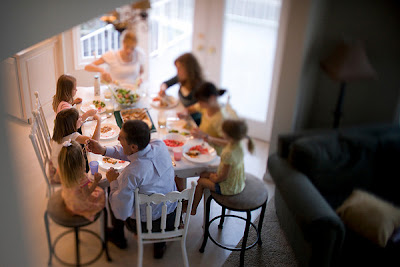
For Seeing the Everyday Magazine
Marc: How would you describe the look of the magazine and how does your photography fit into that look?
Brad: The thing that I like about the magazine is that without ads it looks clean and doesn’t get visually hampered, which makes the pacing work better. I have my own style and it is nice to have a forum for expressing it. I like to visually declutter and use selective focus to get to the heart of what’s going on.
Marc: You mentioned the lack of advertising in the magazine. A lot of people would say that you are missing out on a key source of revenue. How did you come to that decision?
Brad: Early on, we decided that we didn’t want the clutter that you get when you look at a small magazine with too many advertisements. But the biggest reason is that it tends to start to drive content, and with advertising we would be constrained and wouldn’t be able to say what we want to say as much.

For Seeing the Everyday Magazine. Don’t get mad, get the camera
Marc: Do you think other people should adopt your attitude toward advertising?
Brad: Well, that was a decision we made and I wouldn’t want to say that others have to follow it, but at the same time, I do think that advertising can overtake content. For example, a photography magazine that I subscribe to ran an ad on their cover.
That was one of the first times I’ve written a letter to the Editor, because to me, that’s one of those lines you just don’t cross. The same thing happens at college football games where even the waves are sponsored by local restaurant chains.
Marc: The magazine’s tag-line is “finding poetry in the prosaic.” How do you get inspired to do that as a photographer?
Brad: I think that’s how I’ve always thought. I think that’s what first drew me to photography. Even in the first photography class I ever took, it wasn’t like I wanted to take pictures of the Grand Canyon or something. I just liked looking around in my everyday life and finding the beauty there, because there is beauty everywhere.
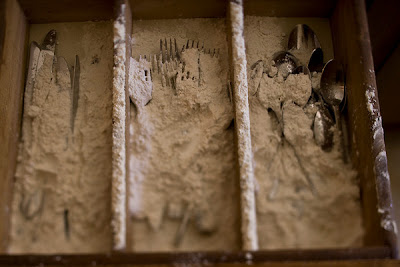
For Seeing the Everyday Magazine. Don’t get mad, get the camera
Marc: Do you hope to inspire other people to the same things?
Brad: I think that we [at the magazine] have given up some things…I mean, I think when we started I thought this would be an opportunity to create some kind of an art piece. But I think that idea of creating “art” has given way to creating a really pro-family messeage, something we hope will be helpful to people in raising their own family. I would hope that people would be inspired to record their own family situation, but the biggest thing we want is to empower people to better.
Marc: What are your own sources of inspiration?
Brad: For me, personally, I love Wendell Barry and that whole school of thought around him. I love his thinking about bringing life down to the fundamental things and trying to appreciate the things that don’t cost money. Photographically, I have a lot of influences, but I wouldn’t know where to start.
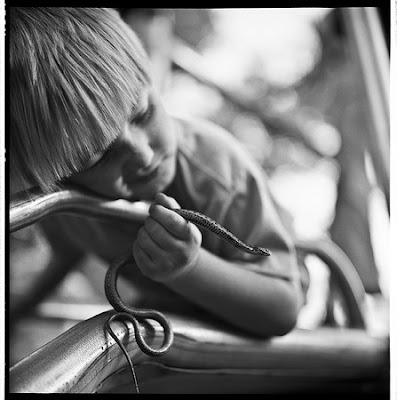
"My son caught a snake."
Marc: How do you see your work in relation to trends that you are noticing right now in photography?
Brad: I remember coming out of school and feeling like I was kind of hip and had a look that was pretty cool, and then at one point I realized that it’s always going to be a game of catch-up if you try to figure out “what’s the look now?” And it’s not that I don’t pay attention, but at the same time, I have tried to steer away from taking pictures that might look super dated—and I’m not sure if some people will agree that I’ve achieved that. Some people might think that my use of selective focus is already dated to a decade ago, but…[laughs] But I think that in art, you always have realism and the abstract, and the classical and the romantic all battling each other, and in photography, too, those impulses compete. In my work, I try to balance the two.
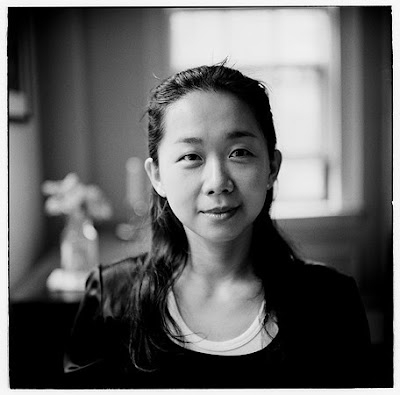
For Seeing the Everyday Magazine As a young girl, Yi-Chiun would rarely talk, which left people around her thinking she wasn’t very bright. Her dad had faith in her, and with his encouragement Yi-Chiun recently finished her graduate studies at Harvard.
Marc: Maybe you can comment on some of your work, both for the magazine and on your own.
Brad: I have a project of my own that started as me wanting to share the life of my family, to preserve this little moment and help my grandkids and their kids to see what it was like to be a part of our family. But then I’d show people, and they’d get excited, and so I started to think about doing a book project or something.
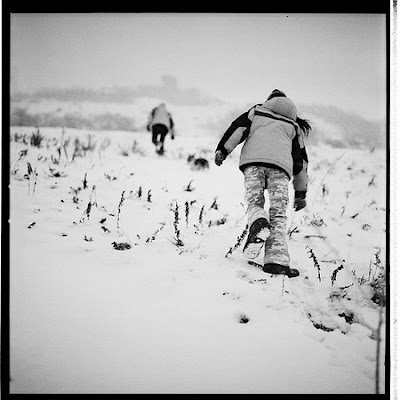
"On a morning hike with my daughters."
Marc: Do you imagine putting text with the photos?
Brad: I’m toying with adding some journal entries, but more as an abstract visual element. I’m kind of taking inspiration from Henri Matisse and his Jazz book where he includes notes in his own handwriting.
Marc: What is your process in shooting?
Brad: I mostly shoot digital, except when I shoot black and white. In that case, I scan the film. But I am kind of ambivalent about digital. I don’t like the way highlights blow out in digital, and I worry about losing digital files, whereas I still have negatives that I took in my first photo class in ’77. I wonder about migrating digital images from format to format as technology changes.
Marc: Do you do all of the photography for the magazine?
Brad: Basically, yes, but one of my favorite pictures we have published is one that my Dad took of my Mom.
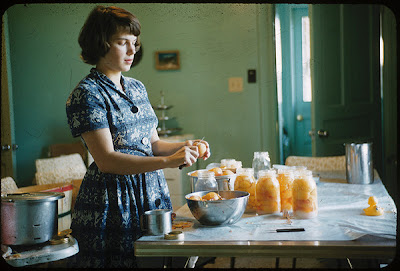
Photo of Brad's Mom taken by his father.
Marc: Did your Dad do a lot of photography?
Brad: He did. That’s really what turned me on to it. He and I had a Leica back in the day and would take a lot of pictures when we traveled. I remember in ’76, we were in France up on the fourth floor of a building and my sister threw the camera out the window.
Marc: The Leica?
Brad: Yeah, the Leica and a Rolleiflex.
Marc: Ouch.
Marc: Any advice for people taking candid photos of their own family?
Brad: Turn off your flash. Pay attention to the light. It seems like a lot of times people don’t pay attention to what’s going on with the light.
Marc: Of course, if people are using a little point-and-shoot and they turn off their flash, won’t they have a lot of noise in their photos?
Brad: Maybe, but I would rather have noise than flash. One more thing about taking pictures, is that I think you’ve got to be in love with the subject. I think it’s got to be more about the subject than about creating art.
Marc: Which I guess makes your home life a good subject?
Brad: I’m not saying that everyone has to take pictures of their families, but that you need to take pictures of what you love. Often, when I tell people that I take pictures of my kids, they think that’s not serious, that I ought to be taking pictures of landscapes or different things. But, you know, I love my kids way more than—I mean, I love landscapes, but I love my kids best of all.


 Let's look at three of the five icons above (yours may vary slightly):