Showing posts with label Interview. Show all posts
Showing posts with label Interview. Show all posts
Wednesday, September 8, 2010
Thank you "Life with Kaishon" for a fun interview

Hey, Take-out photo readers...head on over to Life with Kaishon to read me on the opposite side of an interview. It was fun and I loved thinking about the questions she asked me.
And to all you Life with Kaishon readers who might have clicked over to my blog...WELCOME! Stick around and maybe you'll find some tips or inspiration. The theme changes every month and I post on whatever inspires me.


Thursday, July 29, 2010
Interview with Lucy Call
If you've been reading my blog for a while now, you may have heard of Lucy. She has been working with me for almost as long as I've had my blog. Before she moves on to pursue her photography career, I wanted to share some of her amazing work with you. Rather than an interview with a particular theme, I have simply asked Lucy to comment on some of her work. As you will see, Lucy pays close attention to detail and her photos are never detached or overstated. Her vision always contains a strong personal undercurrent.
The following are Lucy's comments:
The following are Lucy's comments:

I chose this photo for a few reasons. I love photographing women and this photo has an elegant feel that I love because of the model, styling and lighting.

This is one of my favorite photos for a couple of reasons. I remember while I was taking the photo, I was getting so obsessed with every little detail. I think my model was going insane because of it. But in the end, I think it paid off and it has the elegant feel that I was hoping to accomplish. I also really love this photo because of the necklace. It was my great grandmother’s and it was given to my mom. I remember when I was little that I always wanted to wear it while playing “dress ups” and on rare occasions, my mom let me get it out of the box and wear it.

This photo is a part of a series that I have been working on for a while now. I have always thought that Bob Dylan’s lyrics are very narrative and while I listen to his songs, I get such a vivid picture of what he is singing about. So I decided to take lyrics where he sings about women and make photo illustrations of them. This particular one is from I Shall be Free No. 10. I like this photo because I often have a pre-visualization of what I want a photo to look like and this photo came out exactly how I visualized it.

I honestly don’t have a super exciting reason for liking this photo. One of my favorite things to do is to wander around places like the one seen in this photo and explore and take pictures. That’s exactly what I did this day. So I guess I like this photo because it embodies the feeling from those adventures.

This will probably always be one of my favorite photos, not because I think it is an amazing photo or anything like that. I actually took it with super cheap film and knew very little about photography at the time. The reason I love this photo is because of the memories that I have from this particular day. I took this photo while on a study abroad in France. I was wandering around the city by myself when I came upon these guys doing graffiti at this museum and I wanted to take photos of them so badly. This was the first time that I mustered up the courage to ask someone in my very pathetic sounding French to take their photo. I was pretty proud of myself that they agreed and could actually understand me.

The reason I love this photo is simply for the memories surrounding this place. My dad has repeatedly told the story, and will probably continue to do so, about how when he was little he hid behind the Lotus Café after leaving school early because his teacher got mad at him. The only time I actually ate there my grandma kept going on about how amazing the egg drop soup was. It was alright.
The photo means a lot more to me now than when I took it because the café will soon be torn down to make a parking lot. So I am really happy that I have this photo.


I took both of these photos while I was in China. I love these photos because of the amazing beauty that I was able to experience while there. I was so blown away by the ways that the Chinese people incorporated their houses and rice patties together in their villages. I love the second one of the two because it gives a feel of the entire village.
You can follow Lucy's blog to keep up with her and her work.Friday, August 21, 2009
Interview with Medieval Scholar Jesse Hurlbut
I am pleased to interview Jesse Hurlbut today about triptychs. My interview with him will help give historical context to this month's theme. I am a firm believer in the cross-pollination of art forms. In other words, I think photographers can gain much by looking at other forms of representation.
Jesse has been teaching French Medieval culture for 20 years at the University of Kentucky and at BYU. He received his PhD from Indiana University. In addition to his scholarly pursuits, Jesse is a longtime photo enthusiast. He specializes in landscapes, and his sense of color has been influenced by the sunsets of the Arizona desert, where he was raised. Southern Utah and Southern France are his two current favorite places to take his camera. Lately, he has been energetically exploring the capabilities of the Foveon sensor in his Sigma SD14.
I have to admit that I don't know a lot about the history of triptychs, and I'm guessing that I'm not alone. I have seen some Medieval religious triptychs, but I would love to know how this art form emerged. Is it linked to Christian doctrine of the Trinity in some way?
Diptych of Jean de Cellier
 Polyptych, 1478
To see more triptychs, search the online collection of the Web Gallery of Art.
Jesse has been teaching French Medieval culture for 20 years at the University of Kentucky and at BYU. He received his PhD from Indiana University. In addition to his scholarly pursuits, Jesse is a longtime photo enthusiast. He specializes in landscapes, and his sense of color has been influenced by the sunsets of the Arizona desert, where he was raised. Southern Utah and Southern France are his two current favorite places to take his camera. Lately, he has been energetically exploring the capabilities of the Foveon sensor in his Sigma SD14.

I have to admit that I don't know a lot about the history of triptychs, and I'm guessing that I'm not alone. I have seen some Medieval religious triptychs, but I would love to know how this art form emerged. Is it linked to Christian doctrine of the Trinity in some way?
Medieval triptychs belong to the tradition of adorning the sacred altars in churches starting in the twelfth century. More than just decoration, these altarpieces provided a visual metaphor for the sacred ritual performed in front of them. Altarpieces were typically made of stone, metal, ivory, tapestry, or painted wood panels, often covered with jewels or precious metals. Many altarpieces consist of a single panel depicting a scene from religious history, typically from the life of Christ. In the later middle ages, wealthy patrons commissioned artists to produce small altarpieces that could be folded on hinges, convenient for personal devotions and for transporting. Diptychs consist of two panels, that close like a book. Triptychs have three panels and usually have two ½-size wing panels that fold over a full-size central panel. Each panel would contain a different scene. Indeed, the theological premise of the Trinity (three in one) is nicely represented in the triptych since it contains three images in a single, unified piece of art.

Diptych of Jean de Cellier
By the fifteenth century, huge hinged altarpieces are permanently installed above or behind the altar and could include a dozen or more panels with multiple wings. Even with more panels and wings, these elaborate constructions (called polyptychs) were still usually organized around a tripartite composition. The wings were painted on front and back, although the most spectacular paintings were reserved for the inside panels. It is thought that, in some cases, the wings were opened to reveal the inside only on special feast days. Since portability was no longer an issue, we can imagine that the frame divided into three sections persisted as a convenient way to present and to compartmentalize different scenes.
 Polyptych, 1478
Is there a set method for "reading" a triptych or does it vary greatly from one to the next?
While there is plenty of variation in what to look for from one altarpiece to another, there was a fairly unified method of interpretation that medieval scholars applied not only to religious art, but also to every aspect of daily life. Called exegesis, the technique originally derived from the interpretation of scripture and involved four stages:
1) The historical approach looks for the literal meaning of the thing being studied. For example, the story of Noah’s Ark is about a prophet who saves his family by building a boat.
2) The allegorical approach looks for connections between literal and divine history. Noah’s flood might be viewed as an allegory for Christ’s baptism.
3) The tropological approach studies the moral lesson to be learned from a story. In the example of Noah, one lesson might be that those who obey God as Noah did will be preserved by God.
4) The fourth level of interpretation is the most mystical, requiring deep spiritual contemplation. This anagogical approach leads the soul upward from the materiality of this existence to the immateriality of spiritual understanding.
A triptych can easily incorporate each of these four levels. If the central panel depicts a story from the life of Christ; one of the wing panels might show the allegorical connection of that story to an Old Testament event; the other wing panel might show the donors of the painting contemplating the moral lessons of the two other scenes. The person participating in a sacred ritual at the altar may fulfill the fourth level of interpretation by means of their personal spiritual experience.

The Mérode Altarpiece by Robert Campin (in the Cloisters Museum in New York) is a straightforward example of what I have just described. In the central panel, Angel Gabriel announces to Mary that she will be the mother of the Messiah. In the right panel, Joseph is making mousetraps in his workshop. Allegorically, this refers to the way Christ will ensnare the devil. In the left wing panel, we see the donors who commissioned the artwork peering at the two scenes through a door, as they contemplate the moral implications for themselves (tropological). It is interesting to note that through the windows of the central panel, we see only the sky, while in the two wing panels, we see the world at street level. This is a way of indicating the anagogical or spiritual significance of the central panel over the other two.
What influence do you think the triptych has had on other art forms?
One of the qualities of the triptych is that it juxtaposes images that share something in common, but the thing they have in common may not be apparent until they are placed side by side. Other art forms that exploit this same technique include cinema, where a director may create an association between two otherwise unrelated scenes by placing them one right after the other. This is called montage, and it has become such a strong convention that we often don’t even notice how different the scenes are, because our imagination is so well trained to fill in the gaps.
Another art form that exploits sequential images and the gaps between them are comics. We usually think of comics as telling a story in a chronological sequence that moves from one panel to the next, but the relationships between panels—typically separated by literal gaps—can express much more than progress through time. Scott McCloud, comic book artist and theorist, uses the term closure to talk about how our imagination fills in the spaces between panels. In his analytical comic book, Understanding Comics, he has proposed a short list of some of the possible connections between scenes.
(I’ll quote from an on-line summary, but the fully-illustrated version in his book is worth a look.)
1. Moment-to-moment
The same subject is displayed in adjacent instants, like a movie running jerkily on a slow computer. Very little closure is required.
2. Action-to-action
The focus remains on a single subject, but this time, two separate, consecutive actions are displayed (for example, the first panel might contain a car speeding along, the 2nd the car smashing into a tree).
3. Subject-to-subject
Both panels are within the same scene or idea, but each portrays a different subject. ("John: What more could go wrong? || Catherine: Well, at least Jerry never called! || Telephone: R-ring")
4. Scene-to-Scene
Just what it sounds like: great leaps in time or space. ("Detective: He can't outrun us forever. || Image of darkened house with caption: Ten years later...") Lots o' closure -- deductive reasoning, even -- is often required to link the panels into a single narrative.
5. Aspect to aspect
"Bypasses time for the most part and sets a wandering eye on different aspects of a place, mood, or idea."
6. Non-Sequitur
Panels with no logical relationship. (McCloud argues, though, that any panels placed side by side will inevitably generate the impression of some sort of relationship in the reader's mind. "--alchemy at work in the space between panels which can help us find meaning or resonance in even the most jarring of combinations."
Since we are trying to do photographic triptychs this month at Take-out Photo, I wonder if you could comment on what a photographer might glean from the tradition of triptychs. Any ideas or inspiration for my readers?
I think it’s most important to think about the relationship between the images you put together. What brings these pictures together? Is it shape, line, color, light, or texture? Is it some symbolic connection? Three siblings? Three fruits? Three animals? Perhaps the relationship is one of difference, as in an example of the three states of water: a river, an ice cube, and steam.
My second suggestion is related to the first, but has to do with order. Do you want your images to be read from left to right (as with a comic book) or do you want the outside photos to provide a symbolic frame for the center photo (as with a religious triptych)? What visual clues can you give your audience to make sure they correctly perceive the order?
Third, just as composition is important for individual photographs, the overall composition of the combined triptych is essential to consider. Will all three photos be the same size and shape? How does my eye travel from one image to the next? Symmetry is easy with three, but perhaps an overall asymmetrical composition fits your subject better.
To see more triptychs, search the online collection of the Web Gallery of Art.
Sunday, June 14, 2009
Interview with Florian Fritsch of Hobokollektiv
This is the first time I have chosen a "Monthly Special" topic based on an interview I wanted to do. Florian Fritsch has been an active participant here at Take-out Photo, which led me to his site. When I was first looking through his hobokollektif posts, I was struck by the artful combination of text—in particular, lyrics—and image. Music permeates his photography, and each image seems to contain a secret soundtrack, a part of which he reveals with a quote. The following interview takes a look at his creative process and work.
NOTE: All photos in this post are copyright Florian Fritsch. Please respect the copyright of my guests.
What sparked your interest in photography?
Most notably, I've been interested in telling all kinds of stories since I was a kid. Twenty-five years ago I started to write poems. Looking back, writing poetry for me was a way of taking photos with your head and a pencil but without a camera. I got a head full of stories, music and pictures that needed to get out. For my fifteenth birthday, I got my first camera and rolls of film. Hence, I dropped the pencil and was out on the street immediately. I was wandering around the city with a friend of mine, taking pictures, and we were processing them all by ourselves in my little bathroom.
Photography for me is just another way of storytelling like writing books or composing songs. It gives me the opportunity to be right in the heart of things and to keep a distance at the same time.
I guess it all started with words. Spoken, sung, and written words evoke pictures in my head. And for me, it seemed inevitable to take this pictures one day.
How has your style developed or changed over time?
That is a pretty tough question, Marc, because I don't know how to describe my style.
I have studied the works of Robert Frank, Anthony Hernandez, and Saul Leiter for a long time now. There is something in their pictures that really touches me and that I can hardly describe, but I know that I wanted to take pictures like they did. Besides, I think my way of photographing is influenced by the music I listen to, the books I read, and the place I live.
Music and books have always been an inspiration to me because they let my imagination paint pictures to words. Since I stopped leaving home without a camera, I noticed that I look at things differently. I'm more interested in details, and I hope this leaves room for interpretation on the part of the viewer.
I live in Berlin and one of the things I really love about living in a big city is drawing attention to the things that we pass by every day but we often do not recognize— the anonymity and the city's rough edges. You can find beauty on a simple painted wall, an ashtray on a wet table, or in the middle of a deserted main street at midnight. David of the lowrevolution blog once wrote a comment saying that he likes the griminess of my images. And that's pretty close to what I think about my photos and how I wanted them to be looked at.
Tell me about the name of your photoblog.
I want to look at amateur photographers as the hobos of our time somehow, especially when I look at the works of Robert Frank (The Americans) and Anthony Hernandez (Waiting, Sitting, Fishing and some Automobiles) that I mentioned earlier. I'm interested in the stories behind these "songs about roving, rambling and plain hard luck," which actually is a subtitle of a song book. When I started my photoblog I thought about creating a place for like-minded people to share their love for photos, words and music. That's why I called it "Kollektiv": A collective of hobos that tell their own stories about migration, abandonment, isolation, loneliness and luck.
I'm always lucky when I get comments with quotations of films, books or songs paired with personal experiences. It’s all about the pictures and some words that need room to breathe and that want to be spread around this world.
Your use of lyrics with photography inspired this month's theme. The words and images work so well together that I have to ask which comes first—do you shoot with words in mind or do you make the connection after you capture the photo?
Mostly I choose the words after capturing the photo. The processing of a photo is a very intimate and private moment for me. I always listen to music while I work on my photos. That means looking at my photos, choosing the right one to post on the hobokollektiv and the processing of a photo is always combined with heavy vinyl rotation. Sometimes it's easier to find the right lyrics because of the story of the picture. Some pictures got married to a lot of songs, got divorced and found new partners.
 HILLBILLY
He’s a Hollywood hillbilly his stereo is blaring Willie / Johhny Cash, Hank and Lefty down to Sunset and Vine (Dale Watson)
The “hillbilly” photo was hard work to find the appropriate lyrics to. Because it features Jack Nicholson, I watched the film "The Shining" again for maybe using some quotation for the photo. But I wasn't satisfied with it. So I went back to my records and listened to a hundred songs to find the right one. Weeks later, I picked up a Dale Watson record and listened to the “Hollywood Hillbilly” song by chance. And there it was: Hollywood, Jack Nicholson, and the great four Willie, Johnny, Hank and Lefty.
 POINT BLANK
From time to time, it happens that I know the words the moment I look through the viewfinder and take the picture. An example for this case is my contribution to your monthly special about colour. Bruce Springsteen’s “The River” album is one of the most impressive pieces of music I have ever listened to. I knew while taking the picture that “Point Blank” was the song that best describes what I captured and that it could only be that song.
I got so used to the word and image combination that I nearly always have to quote some more or less known song when looking at other people’s photos. At least it’s like T. C. Boyle once said in an interview: “It all comes natural, man.”
What advice would you give to people who want to create more expressive (and even lyrical) images?
I am a self-taught photographer. For that reason I don’t know if it’s up to me to give some advice. But I would like to say what is important to me.
Taking pictures is finding your own point of view and looking for stories to tell. The world is full of great songs and lyrics. Songs and words are both there to be used. The pleasure comes when you let your imagination do the work. For example: There are many songs out there dealing with driving, cars and roads. But what is a road or what does it stand for? Is it just a way to get from here to there? Is it symbol for decisions we all have to make someday or the ways we all had to go? Does it tell us something about leaving and arrival, companionship or loneliness? Is it a symbol for freedom or are there people who walk on roads to escape from poverty and find work? So go ahead and listen to all kinds of music and read good books. The photos will follow.
I try to keep it simple and minimalistic. I never use a flash because this draws attention to the photographer who should never be on the center stage. And most important to me is that every picture needs time to be composed. Some of my pictures need weeks or months to be finished. That can be discouraging, but on the other hand it gives me time to listen to another song. And every picture sings a song.
I love hearing the story behind the photo. Could you share some of your own favorites?
Let’s look at “the glitter & the roar” photo:
 THE GLITTER & THE ROAR
The desire to have much more, all the glitter and the roar / I know this is where the sidewalk ends (Tom Waits)
I was listening to Tom Waits extensively while I was working on a series about neon signs and street lights. The neon lights captured here belong to an old independent movie theatre which still shows movies, and I was attending a reading by T. C. Boyle there when I took the picture. Thinking about the death of these beautiful, old and independent cinemas through replacing them with huge modern movie complexes and listening to Tom Waits singing “Fannin Street” just brought together what always seems to belong together: An old song for some good old-time feeling.
 PITCH BLACK NIGHT
And I’m driving in a stolen car on a pitch black night / And I’m telling myself I’m gonna be alright / But I ride by night and I travel in fear / That in this darkness I will disappear (Bruce Springsteen)
I like the “pitch black night” photo because of a simple story: I was thinking about some serious decisions I have to make. After meeting a dear friend to talk things over I went home through a pitch black winter night in Berlin. Seems like everybody had already gone to sleep while I was walking through a half empty city singing Springsteen's great “Stolen Car” to myself and feeling completely alone in the biggest German city. I looked down this street and took a photo. Every time I felt downhearted or kind of sad I used to look at this picture, listen to that song, and I started to feel better. Months later I showed this picture to a friend who went through some pretty sad times and his reaction was the same as mine.
 MORNING IN BERLIN
Blattlos die Bäume, deren Gerippe in den Tag ragten, als reckten sich knochige Finger in die feuchte Luft. (Beverungen)
The “Morning in Berlin” picture is actually from a series that I started after buying a new camera. I take a picture of this tree every morning at the same time. It became part of my morning routine after having breakfast, coffee, and a cigarette. It was inspired by the film “Smoke” where the main character Auggie Wren always takes one photo every morning at the same place without looking through the viewfinder. And I like the idea that I will look at hundreds of tree photos in some years, find things I never noticed before and build up a photography forest.
 "Restless No More"
Well I’ve been throughout this land / North & east & back again / Roamin’ around in my old Volkswagen (SongDogs)
The “restless no more” photo was taken on a road to Orange in southern France. I have known this road for a very long time and I have been fascinated by straight roads like this ever since I saw a photo by Robert Frank of the interstate 285 in New Mexico. I knew then that my photo must be taken on that road which was originally built by the Romans. Last year I finally sat down in the middle of this road and made this picture that I've been planning to take for more than ten years and that I've been writing songs about ever since I picked up a guitar. This road and I have some kind of longtime relationship and I always call this road my road.
 LANGHORNE SLIM
There's no road to follow / only stones left unturned / You must play with fire / in order to get burned (Langhorne Slim)
“Langhorne Slim”: This one is not yet published on the hobokollektiv. But since this monthly special is about photos and music, and I feel very honored to inspire this monthly special, I saved it for a special moment. This special moment is now, Marc. This man is a hell of a songwriter that constantly rocks my soul with his fine folk music. His lyrics are an inspiration to me most every day. The story behind it: No song that can't be sung, no photo that can't be taken. Thanks for letting me inspire this monthly special and having me on your blog.
Thank you, Fristch, for sharing your work and words.
NOTE: All photos in this post are copyright Florian Fritsch. Please respect the copyright of my guests.
What sparked your interest in photography?
Most notably, I've been interested in telling all kinds of stories since I was a kid. Twenty-five years ago I started to write poems. Looking back, writing poetry for me was a way of taking photos with your head and a pencil but without a camera. I got a head full of stories, music and pictures that needed to get out. For my fifteenth birthday, I got my first camera and rolls of film. Hence, I dropped the pencil and was out on the street immediately. I was wandering around the city with a friend of mine, taking pictures, and we were processing them all by ourselves in my little bathroom.
Photography for me is just another way of storytelling like writing books or composing songs. It gives me the opportunity to be right in the heart of things and to keep a distance at the same time.
I guess it all started with words. Spoken, sung, and written words evoke pictures in my head. And for me, it seemed inevitable to take this pictures one day.
How has your style developed or changed over time?
That is a pretty tough question, Marc, because I don't know how to describe my style.
I have studied the works of Robert Frank, Anthony Hernandez, and Saul Leiter for a long time now. There is something in their pictures that really touches me and that I can hardly describe, but I know that I wanted to take pictures like they did. Besides, I think my way of photographing is influenced by the music I listen to, the books I read, and the place I live.
Music and books have always been an inspiration to me because they let my imagination paint pictures to words. Since I stopped leaving home without a camera, I noticed that I look at things differently. I'm more interested in details, and I hope this leaves room for interpretation on the part of the viewer.
I live in Berlin and one of the things I really love about living in a big city is drawing attention to the things that we pass by every day but we often do not recognize— the anonymity and the city's rough edges. You can find beauty on a simple painted wall, an ashtray on a wet table, or in the middle of a deserted main street at midnight. David of the lowrevolution blog once wrote a comment saying that he likes the griminess of my images. And that's pretty close to what I think about my photos and how I wanted them to be looked at.
Tell me about the name of your photoblog.
I want to look at amateur photographers as the hobos of our time somehow, especially when I look at the works of Robert Frank (The Americans) and Anthony Hernandez (Waiting, Sitting, Fishing and some Automobiles) that I mentioned earlier. I'm interested in the stories behind these "songs about roving, rambling and plain hard luck," which actually is a subtitle of a song book. When I started my photoblog I thought about creating a place for like-minded people to share their love for photos, words and music. That's why I called it "Kollektiv": A collective of hobos that tell their own stories about migration, abandonment, isolation, loneliness and luck.
I'm always lucky when I get comments with quotations of films, books or songs paired with personal experiences. It’s all about the pictures and some words that need room to breathe and that want to be spread around this world.
Your use of lyrics with photography inspired this month's theme. The words and images work so well together that I have to ask which comes first—do you shoot with words in mind or do you make the connection after you capture the photo?
Mostly I choose the words after capturing the photo. The processing of a photo is a very intimate and private moment for me. I always listen to music while I work on my photos. That means looking at my photos, choosing the right one to post on the hobokollektiv and the processing of a photo is always combined with heavy vinyl rotation. Sometimes it's easier to find the right lyrics because of the story of the picture. Some pictures got married to a lot of songs, got divorced and found new partners.
 HILLBILLY
The “hillbilly” photo was hard work to find the appropriate lyrics to. Because it features Jack Nicholson, I watched the film "The Shining" again for maybe using some quotation for the photo. But I wasn't satisfied with it. So I went back to my records and listened to a hundred songs to find the right one. Weeks later, I picked up a Dale Watson record and listened to the “Hollywood Hillbilly” song by chance. And there it was: Hollywood, Jack Nicholson, and the great four Willie, Johnny, Hank and Lefty.
 POINT BLANK
But tomorrow’s fall in number, in number one by one / You wake up and you’re dying you don’t even know what from (Bruce Springsteen)
From time to time, it happens that I know the words the moment I look through the viewfinder and take the picture. An example for this case is my contribution to your monthly special about colour. Bruce Springsteen’s “The River” album is one of the most impressive pieces of music I have ever listened to. I knew while taking the picture that “Point Blank” was the song that best describes what I captured and that it could only be that song.
I got so used to the word and image combination that I nearly always have to quote some more or less known song when looking at other people’s photos. At least it’s like T. C. Boyle once said in an interview: “It all comes natural, man.”
What advice would you give to people who want to create more expressive (and even lyrical) images?
I am a self-taught photographer. For that reason I don’t know if it’s up to me to give some advice. But I would like to say what is important to me.
Taking pictures is finding your own point of view and looking for stories to tell. The world is full of great songs and lyrics. Songs and words are both there to be used. The pleasure comes when you let your imagination do the work. For example: There are many songs out there dealing with driving, cars and roads. But what is a road or what does it stand for? Is it just a way to get from here to there? Is it symbol for decisions we all have to make someday or the ways we all had to go? Does it tell us something about leaving and arrival, companionship or loneliness? Is it a symbol for freedom or are there people who walk on roads to escape from poverty and find work? So go ahead and listen to all kinds of music and read good books. The photos will follow.
I try to keep it simple and minimalistic. I never use a flash because this draws attention to the photographer who should never be on the center stage. And most important to me is that every picture needs time to be composed. Some of my pictures need weeks or months to be finished. That can be discouraging, but on the other hand it gives me time to listen to another song. And every picture sings a song.
I love hearing the story behind the photo. Could you share some of your own favorites?
Let’s look at “the glitter & the roar” photo:
 THE GLITTER & THE ROAR
I was listening to Tom Waits extensively while I was working on a series about neon signs and street lights. The neon lights captured here belong to an old independent movie theatre which still shows movies, and I was attending a reading by T. C. Boyle there when I took the picture. Thinking about the death of these beautiful, old and independent cinemas through replacing them with huge modern movie complexes and listening to Tom Waits singing “Fannin Street” just brought together what always seems to belong together: An old song for some good old-time feeling.
 PITCH BLACK NIGHT
I like the “pitch black night” photo because of a simple story: I was thinking about some serious decisions I have to make. After meeting a dear friend to talk things over I went home through a pitch black winter night in Berlin. Seems like everybody had already gone to sleep while I was walking through a half empty city singing Springsteen's great “Stolen Car” to myself and feeling completely alone in the biggest German city. I looked down this street and took a photo. Every time I felt downhearted or kind of sad I used to look at this picture, listen to that song, and I started to feel better. Months later I showed this picture to a friend who went through some pretty sad times and his reaction was the same as mine.
 MORNING IN BERLIN
The “Morning in Berlin” picture is actually from a series that I started after buying a new camera. I take a picture of this tree every morning at the same time. It became part of my morning routine after having breakfast, coffee, and a cigarette. It was inspired by the film “Smoke” where the main character Auggie Wren always takes one photo every morning at the same place without looking through the viewfinder. And I like the idea that I will look at hundreds of tree photos in some years, find things I never noticed before and build up a photography forest.
 "Restless No More"
The “restless no more” photo was taken on a road to Orange in southern France. I have known this road for a very long time and I have been fascinated by straight roads like this ever since I saw a photo by Robert Frank of the interstate 285 in New Mexico. I knew then that my photo must be taken on that road which was originally built by the Romans. Last year I finally sat down in the middle of this road and made this picture that I've been planning to take for more than ten years and that I've been writing songs about ever since I picked up a guitar. This road and I have some kind of longtime relationship and I always call this road my road.
 LANGHORNE SLIM
“Langhorne Slim”: This one is not yet published on the hobokollektiv. But since this monthly special is about photos and music, and I feel very honored to inspire this monthly special, I saved it for a special moment. This special moment is now, Marc. This man is a hell of a songwriter that constantly rocks my soul with his fine folk music. His lyrics are an inspiration to me most every day. The story behind it: No song that can't be sung, no photo that can't be taken. Thanks for letting me inspire this monthly special and having me on your blog.
Thank you, Fristch, for sharing your work and words.
Saturday, April 25, 2009
Interview with Ilan Bresler
I am happy to present an interview this month with Ilan Bresler. Readers of Take-Out Photo will recognize his name from his participation in the monthly specials. Since I always visit the site of people who participate, I began browsing through his work and became increasingly impressed with his point of view. As you will see from this interview, Ilan puts a lot of serious thought into his photography, and I think it shows in his work.
—Note: Please respect the copyright of my guests' work.
How did you first become interested in photography?
Almost since I can remember, I've been into photography. I was born in Belarus, and my family migrated to Israel when I was 8. The language barrier was kind of a trauma, I guess, and as a way to overcome it I used my grandfather's old camera. So, till about 7th grade I was the “Russian kid with the funny looking camera”.
In high school it got too awkward, so I dropped the hobby for a time, but almost as soon as the digital cameras appeared I got one for myself – A small 3 megapixel Nikon 3100 camera. I had a few frames I felt were not too bad and after an agonizing period of trying to overcome my shyness, I decided to post them on a photo forum.
The comments felt almost like an adrenalin rush to me. Pretty soon, a few of the more experienced members of that forum took me under their wing and I quickly found myself surrounded by an inspiring group of photo-mentors.
 The easiest side of street photography – “sign and object” kind of photos. Street photos are not only about people.
Tell us about some of the photographers and/or artists that inspire you.
First of all, those photo-mentors I’ve mentioned earlier. I learned something different from each and every one of them. I’m only sorry that none of them has a website I can link to. They influenced me in many ways. One told me about composition, the other, the technical side of photography. One introduced me to Yasuhiro Ishimoto, the other to Henri Cartier-Bresson. A very important lesson and one of the first I learned was that the fact that I’m using a digital camera doesn’t mean I can just shoot without thinking—“Think and then shoot” became a motto.
A funny thing is that this motto lead me to use my digital camera in the same way I used my film camera few years earlier. I might come back from a trip with no more than 40-50 photos while my other “digital photo” friend would come back with more than 400 photos.
Over the years I bought many photography related books, mainly books of those considered to be “Masters of Photography.” Apart from those photographers I mentioned earlier, I find that in different parts of my life I was influenced by different Masters – Sebastian Salgado, Martin Parr, William Eggleston, Eugene Smith. Also, Israeli photographers like Alex Levac and Vardi Kahana. In-public.com is another great inspiration for me; I visit it almost on a daily basis, going through the photos over and over and over again (Nils Jorgensen is my favorite). However, the biggest influence was a Russian/Israeli photographer I encountered almost by accident—Julia Komissaroff. Her use of a wide angle lens in street photography, the feeling that she is right in the middle of the situation, a part of it, left a very significant impact on me. She made me try and learn to overcome our natural fear of taking photos of people up close.
 “Think and then shoot” was a new direction which I still follow.
After a few years of photo-forum activity and after starting two photo-related forums myself (both are still active) I got a bit tired of “forum critiques.” I just didn’t feel it contributed to my progress anymore. I felt I have found a formula that will always bring me lots of “Wows!” and praise comments, but that kind of photography lost much of its appeal to me. I didn’t want to get “stuck” on that level.
Meanwhile, I was invited to participate in a few exhibitions and even had an option for a solo exhibition, but I always thought that my photos weren't good enough to waste someone’s time or in the worst case, money.
Flickr was just a nice way to keep my photos online so I can send a link to a friend and/or those whose critique I'm interested in.
One night, on an impulse, I bought a URL address and started a photoblog. I still don’t know why I did that, and I still think my photos are not that good, but I never regretted doing that— I have discovered many new photographers and blogs which influence me, whether it’s a new technique or a new idea or an online interview :)
 The feeling of being stuck lead me to photoblogging.
As you know, take-out photo is exploring street photography this month. How do you manage to capture so many great moments? Do you carry your camera with you at all times?
Most of my more successful street photos, I got while traveling abroad. The reason for that is while I’m in another country, the camera is glued to my hand. However, on my daily routine which consists of a train ride to my office and back, going around the whole day with a DSLR is not something that I will consider. It’s just too much hassle.
By connecting these two facts I’ve decided to buy a compact camera that will answer my needs without limiting me too much—so I got myself a Ricoh GX200. That camera, for me, combines all the significant features needed for street photography. It’s fast, it has RAW support (a must) and a 24mm wide lens. And although the camera has its limitations (over 200 ISO the photos are almost unrecognizable) it fulfills my needs and more.
 A compact camera brought the hobby to my everyday routine. Photo inspired by Martin Parr.
 That’s what I love in Nils Jorgensen’s gallery whom I mentioned earlier—it’s all about those small nuances we see every day, but that we never really look at.
Street photography is not only about people; it’s about situations. People are just another (important, no doubt about it) ingredient.
Street photography is not only black and white. I don’t know why most tend to convert their frame to B&W, maybe because it gives that classic feeling, but sometimes shapes and colors are no less important than the situation itself (Martin Parr’s works are good example for that).
And my most important “rule”, I think, is – “don’t try to impress your critics.” I don’t take or post photos that I think will get the most praise. I take and post photos that I personally love and enjoy.
Tell us about some of your favorite photos.
That’s a tough one. Photos that become my favorite are usually those where I was able to capture a combination of “layers.” Mainly I enjoy those where I manage to include a layer of humor.
The photo below is one near the American embassy in Prague. I saw that frame building up in front of me in a matter of seconds. I jumped so quickly that I startled my girlfriend who stood next to me, and even before I saw the result back home, I felt it was going to be a “nice one”.

On the next one I just saw the sign and waited for the right “shape” to enter the frame. Today I find such photography a bit too easy—it’s all there, you just need to be patient enough.

Thank you, Ilan, for a great interview.
Thank you, Marc for having me on your blog.
You can check out more of Ilan's work on his photoblog and his flickr site.
—Note: Please respect the copyright of my guests' work.
How did you first become interested in photography?
Almost since I can remember, I've been into photography. I was born in Belarus, and my family migrated to Israel when I was 8. The language barrier was kind of a trauma, I guess, and as a way to overcome it I used my grandfather's old camera. So, till about 7th grade I was the “Russian kid with the funny looking camera”.
In high school it got too awkward, so I dropped the hobby for a time, but almost as soon as the digital cameras appeared I got one for myself – A small 3 megapixel Nikon 3100 camera. I had a few frames I felt were not too bad and after an agonizing period of trying to overcome my shyness, I decided to post them on a photo forum.
The comments felt almost like an adrenalin rush to me. Pretty soon, a few of the more experienced members of that forum took me under their wing and I quickly found myself surrounded by an inspiring group of photo-mentors.
 The easiest side of street photography – “sign and object” kind of photos. Street photos are not only about people.
Tell us about some of the photographers and/or artists that inspire you.
First of all, those photo-mentors I’ve mentioned earlier. I learned something different from each and every one of them. I’m only sorry that none of them has a website I can link to. They influenced me in many ways. One told me about composition, the other, the technical side of photography. One introduced me to Yasuhiro Ishimoto, the other to Henri Cartier-Bresson. A very important lesson and one of the first I learned was that the fact that I’m using a digital camera doesn’t mean I can just shoot without thinking—“Think and then shoot” became a motto.
A funny thing is that this motto lead me to use my digital camera in the same way I used my film camera few years earlier. I might come back from a trip with no more than 40-50 photos while my other “digital photo” friend would come back with more than 400 photos.
Over the years I bought many photography related books, mainly books of those considered to be “Masters of Photography.” Apart from those photographers I mentioned earlier, I find that in different parts of my life I was influenced by different Masters – Sebastian Salgado, Martin Parr, William Eggleston, Eugene Smith. Also, Israeli photographers like Alex Levac and Vardi Kahana. In-public.com is another great inspiration for me; I visit it almost on a daily basis, going through the photos over and over and over again (Nils Jorgensen is my favorite). However, the biggest influence was a Russian/Israeli photographer I encountered almost by accident—Julia Komissaroff. Her use of a wide angle lens in street photography, the feeling that she is right in the middle of the situation, a part of it, left a very significant impact on me. She made me try and learn to overcome our natural fear of taking photos of people up close.
 “Think and then shoot” was a new direction which I still follow.
I notice that you maintain both a photoblog and a Flickr account. How has sharing your photos on the web impacted your work?
I never thought or planned to start photoblogging, actually.After a few years of photo-forum activity and after starting two photo-related forums myself (both are still active) I got a bit tired of “forum critiques.” I just didn’t feel it contributed to my progress anymore. I felt I have found a formula that will always bring me lots of “Wows!” and praise comments, but that kind of photography lost much of its appeal to me. I didn’t want to get “stuck” on that level.
Meanwhile, I was invited to participate in a few exhibitions and even had an option for a solo exhibition, but I always thought that my photos weren't good enough to waste someone’s time or in the worst case, money.
Flickr was just a nice way to keep my photos online so I can send a link to a friend and/or those whose critique I'm interested in.
One night, on an impulse, I bought a URL address and started a photoblog. I still don’t know why I did that, and I still think my photos are not that good, but I never regretted doing that— I have discovered many new photographers and blogs which influence me, whether it’s a new technique or a new idea or an online interview :)
 The feeling of being stuck lead me to photoblogging.
As you know, take-out photo is exploring street photography this month. How do you manage to capture so many great moments? Do you carry your camera with you at all times?
Most of my more successful street photos, I got while traveling abroad. The reason for that is while I’m in another country, the camera is glued to my hand. However, on my daily routine which consists of a train ride to my office and back, going around the whole day with a DSLR is not something that I will consider. It’s just too much hassle.
By connecting these two facts I’ve decided to buy a compact camera that will answer my needs without limiting me too much—so I got myself a Ricoh GX200. That camera, for me, combines all the significant features needed for street photography. It’s fast, it has RAW support (a must) and a 24mm wide lens. And although the camera has its limitations (over 200 ISO the photos are almost unrecognizable) it fulfills my needs and more.
 A compact camera brought the hobby to my everyday routine. Photo inspired by Martin Parr.
When not using the compact camera, 99.9% of the time I use a wide angle 17-50mm lens by Tamron. I own an 18-200mm lens, which sounds like the ideal lens for street photography, but the lens is just not fast enough and spends most of the time in my backpack. I don’t believe in going out to a street with lenses with over 70mm range—telephoto takes away that special feeling of actually being there at the scene and maybe it will sounds a bit weird, but it doesn’t feel right for me to “steal” street shots from a distance.
When walking around with my camera, I set my mind to “photo mode.” I’m very aware of my surroundings; the camera is always ready to shoot and the more I do it, the more I practice it, the “easier” it gets for me to get in that mode and the results are getting better. Or at least that’s what I would like to think.
Do you have any advice that may help readers who are new to street photography?
I’m not sure I’m in a position to give advice, but these are the “rules” I tend to follow:
The tiniest nuances can become a good photo.
I was standing next to this couple and I saw they were a millisecond before kissing each other. I took the photo, and here is the result:
When walking around with my camera, I set my mind to “photo mode.” I’m very aware of my surroundings; the camera is always ready to shoot and the more I do it, the more I practice it, the “easier” it gets for me to get in that mode and the results are getting better. Or at least that’s what I would like to think.
Do you have any advice that may help readers who are new to street photography?
I’m not sure I’m in a position to give advice, but these are the “rules” I tend to follow:
The tiniest nuances can become a good photo.
I was standing next to this couple and I saw they were a millisecond before kissing each other. I took the photo, and here is the result:
 That’s what I love in Nils Jorgensen’s gallery whom I mentioned earlier—it’s all about those small nuances we see every day, but that we never really look at.
Street photography is not only about people; it’s about situations. People are just another (important, no doubt about it) ingredient.
Street photography is not only black and white. I don’t know why most tend to convert their frame to B&W, maybe because it gives that classic feeling, but sometimes shapes and colors are no less important than the situation itself (Martin Parr’s works are good example for that).
And my most important “rule”, I think, is – “don’t try to impress your critics.” I don’t take or post photos that I think will get the most praise. I take and post photos that I personally love and enjoy.
Tell us about some of your favorite photos.
That’s a tough one. Photos that become my favorite are usually those where I was able to capture a combination of “layers.” Mainly I enjoy those where I manage to include a layer of humor.
The photo below is one near the American embassy in Prague. I saw that frame building up in front of me in a matter of seconds. I jumped so quickly that I startled my girlfriend who stood next to me, and even before I saw the result back home, I felt it was going to be a “nice one”.

On the next one I just saw the sign and waited for the right “shape” to enter the frame. Today I find such photography a bit too easy—it’s all there, you just need to be patient enough.

Thank you, Ilan, for a great interview.
Thank you, Marc for having me on your blog.
You can check out more of Ilan's work on his photoblog and his flickr site.
Wednesday, February 11, 2009
Interview with Brad Slade, Photographer for Seeing the Everyday Magazine
 For Seeing the Everyday Magazine. "My mother has made bread as long as I remember, and the family remembers this was a good time to be with her. She always listened."
NOTE: All photos Copyright Brad Slade.
Marc: Tell me about how you got involved in the Magazine Seeing the Everyday?
Brad: An old friend, Daryl Smith, had been thinking of this magazine for a long time. We had done a few jobs together and he thought I would be a good fit for it. And as we talked about it, I became really excited about the idea of capturing the family and trying to show the everyday moments.

For Seeing the Everyday the Everyday Magazine. "We spend dinnertime with a different family each issue."
Marc: Seeing the Everyday has been described by one blogger as Saturday Evening Post for the modern reader. What do you think of that comparison?
Brad: You know, it’s interesting, because I always think of The Saturday Evening Post as a bit idealizing. We may be idealizing the family in a certain way, but we are more interested in celebrating the family in the nitty gritty of everyday life instead of trying to set up the perfect picture of what a family ought to be.

For Seeing the Everyday Magazine
Marc: How would you describe the look of the magazine and how does your photography fit into that look?
Brad: The thing that I like about the magazine is that without ads it looks clean and doesn’t get visually hampered, which makes the pacing work better. I have my own style and it is nice to have a forum for expressing it. I like to visually declutter and use selective focus to get to the heart of what’s going on.
Marc: You mentioned the lack of advertising in the magazine. A lot of people would say that you are missing out on a key source of revenue. How did you come to that decision?
Brad: Early on, we decided that we didn’t want the clutter that you get when you look at a small magazine with too many advertisements. But the biggest reason is that it tends to start to drive content, and with advertising we would be constrained and wouldn’t be able to say what we want to say as much.

For Seeing the Everyday Magazine. Don’t get mad, get the camera
Marc: Do you think other people should adopt your attitude toward advertising?
Brad: Well, that was a decision we made and I wouldn’t want to say that others have to follow it, but at the same time, I do think that advertising can overtake content. For example, a photography magazine that I subscribe to ran an ad on their cover.
That was one of the first times I’ve written a letter to the Editor, because to me, that’s one of those lines you just don’t cross. The same thing happens at college football games where even the waves are sponsored by local restaurant chains.
Marc: The magazine’s tag-line is “finding poetry in the prosaic.” How do you get inspired to do that as a photographer?
Brad: I think that’s how I’ve always thought. I think that’s what first drew me to photography. Even in the first photography class I ever took, it wasn’t like I wanted to take pictures of the Grand Canyon or something. I just liked looking around in my everyday life and finding the beauty there, because there is beauty everywhere.

For Seeing the Everyday Magazine. Don’t get mad, get the camera
Marc: Do you hope to inspire other people to the same things?
Brad: I think that we [at the magazine] have given up some things…I mean, I think when we started I thought this would be an opportunity to create some kind of an art piece. But I think that idea of creating “art” has given way to creating a really pro-family messeage, something we hope will be helpful to people in raising their own family. I would hope that people would be inspired to record their own family situation, but the biggest thing we want is to empower people to better.
Marc: What are your own sources of inspiration?
Brad: For me, personally, I love Wendell Barry and that whole school of thought around him. I love his thinking about bringing life down to the fundamental things and trying to appreciate the things that don’t cost money. Photographically, I have a lot of influences, but I wouldn’t know where to start.

"My son caught a snake."
Marc: How do you see your work in relation to trends that you are noticing right now in photography?
Brad: I remember coming out of school and feeling like I was kind of hip and had a look that was pretty cool, and then at one point I realized that it’s always going to be a game of catch-up if you try to figure out “what’s the look now?” And it’s not that I don’t pay attention, but at the same time, I have tried to steer away from taking pictures that might look super dated—and I’m not sure if some people will agree that I’ve achieved that. Some people might think that my use of selective focus is already dated to a decade ago, but…[laughs] But I think that in art, you always have realism and the abstract, and the classical and the romantic all battling each other, and in photography, too, those impulses compete. In my work, I try to balance the two.

For Seeing the Everyday Magazine As a young girl, Yi-Chiun would rarely talk, which left people around her thinking she wasn’t very bright. Her dad had faith in her, and with his encouragement Yi-Chiun recently finished her graduate studies at Harvard.
Marc: Maybe you can comment on some of your work, both for the magazine and on your own.
Brad: I have a project of my own that started as me wanting to share the life of my family, to preserve this little moment and help my grandkids and their kids to see what it was like to be a part of our family. But then I’d show people, and they’d get excited, and so I started to think about doing a book project or something.

"On a morning hike with my daughters."
Marc: Do you imagine putting text with the photos?
Brad: I’m toying with adding some journal entries, but more as an abstract visual element. I’m kind of taking inspiration from Henri Matisse and his Jazz book where he includes notes in his own handwriting.
Marc: What is your process in shooting?
Brad: I mostly shoot digital, except when I shoot black and white. In that case, I scan the film. But I am kind of ambivalent about digital. I don’t like the way highlights blow out in digital, and I worry about losing digital files, whereas I still have negatives that I took in my first photo class in ’77. I wonder about migrating digital images from format to format as technology changes.
Marc: Do you do all of the photography for the magazine?
Brad: Basically, yes, but one of my favorite pictures we have published is one that my Dad took of my Mom.

Photo of Brad's Mom taken by his father.
Marc: Did your Dad do a lot of photography?
Brad: He did. That’s really what turned me on to it. He and I had a Leica back in the day and would take a lot of pictures when we traveled. I remember in ’76, we were in France up on the fourth floor of a building and my sister threw the camera out the window.
Marc: The Leica?
Brad: Yeah, the Leica and a Rolleiflex.
Marc: Ouch.
Marc: Any advice for people taking candid photos of their own family?
Brad: Turn off your flash. Pay attention to the light. It seems like a lot of times people don’t pay attention to what’s going on with the light.
Marc: Of course, if people are using a little point-and-shoot and they turn off their flash, won’t they have a lot of noise in their photos?
Brad: Maybe, but I would rather have noise than flash. One more thing about taking pictures, is that I think you’ve got to be in love with the subject. I think it’s got to be more about the subject than about creating art.
Marc: Which I guess makes your home life a good subject?
Brad: I’m not saying that everyone has to take pictures of their families, but that you need to take pictures of what you love. Often, when I tell people that I take pictures of my kids, they think that’s not serious, that I ought to be taking pictures of landscapes or different things. But, you know, I love my kids way more than—I mean, I love landscapes, but I love my kids best of all.
Wednesday, January 28, 2009
Interview with Elain Vallet of Elainev.com
I first happened upon Elaine's blog back in August when I was doing the "photo within a photo" theme. As is the case with all good French people, Elaine was taking a four-week vacation in August. Luckily, she had posted a great photo within a photo shot on her site. I have been admiring her work ever since, so I am happy to share some of it with you in this brief interview
(NOTE: As always, my guests hold the copyright to their work. Please respect it.)
Most of your photography on your blog and website is black and white, is there a reason that you favor black and white photography over color?
My first approach to photography was in black and white, through my father’s photos as a kid, seeing them appear on paper in an improvised darkroom in our flat. Then, I discovered the b&w humanist photographers such as Cartier-Bresson or Ronis and the work of Magnum agency journalists by whom I have been very much influenced.
Besides, I find it easier to convey the sense of a moment without the interference of colors and also because monochromatic settings leave more space for graphics, shadows, lights and contrasts which are very dear to me and I have to admit also much easier to shoot. As far as I’m concerned, colors are terribly difficult to handle…
 Here, the use of b&w gives a sense of unity between the boy, shadow and reflection
How do you decide which photos to leave in color and which ones to convert to black and white?
I hardly ever use film cameras but if I do, it is with b&w films, so that I can do the printing myself in a darkroom, which I find fascinating.
Otherwise, I use my canon digital camera (rebel Xti), taking most of my photos in RAW, for the flexibility of the format. Yet my camera is always on b&w settings, so that I get direct b&w screen control. I have gotten used somehow to thinking in b&w, anticipating what a scene will look like once captured, focusing on lights and shadows.
Nevertheless, I can change back to colors on the computer and sometimes I am pleased with the result and decide to leave it that way, especially when there is one main color in the scene, as a sort of “bichromatic” picture. If you have a look at my galleries, all the color pictures have a clear dominant tone.
 This would be more of a “black and blue” picture than a full “color” picture
Can you share how you convert your photos from color to black and white?
As I have said before, my camera is always on b&w settings, so when I upload the photos onto the computer they are already in b&w. I work on the RAW files with Canon’s software DPP and most of the time I adjust the levels or curves a little to sharpen the contrast. I also enjoy very much the filters effects, especially the red one that is always very efficient on skies and reflections.
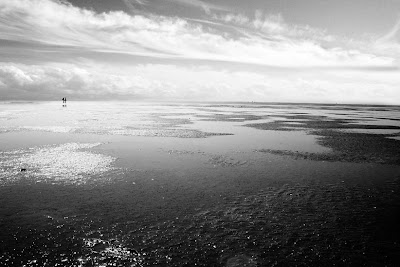 Here the red filter effects make the clouds stand out and the light appear darker.
(NOTE: As always, my guests hold the copyright to their work. Please respect it.)
Most of your photography on your blog and website is black and white, is there a reason that you favor black and white photography over color?
My first approach to photography was in black and white, through my father’s photos as a kid, seeing them appear on paper in an improvised darkroom in our flat. Then, I discovered the b&w humanist photographers such as Cartier-Bresson or Ronis and the work of Magnum agency journalists by whom I have been very much influenced.
Besides, I find it easier to convey the sense of a moment without the interference of colors and also because monochromatic settings leave more space for graphics, shadows, lights and contrasts which are very dear to me and I have to admit also much easier to shoot. As far as I’m concerned, colors are terribly difficult to handle…
 Here, the use of b&w gives a sense of unity between the boy, shadow and reflection
How do you decide which photos to leave in color and which ones to convert to black and white?
I hardly ever use film cameras but if I do, it is with b&w films, so that I can do the printing myself in a darkroom, which I find fascinating.
Otherwise, I use my canon digital camera (rebel Xti), taking most of my photos in RAW, for the flexibility of the format. Yet my camera is always on b&w settings, so that I get direct b&w screen control. I have gotten used somehow to thinking in b&w, anticipating what a scene will look like once captured, focusing on lights and shadows.
Nevertheless, I can change back to colors on the computer and sometimes I am pleased with the result and decide to leave it that way, especially when there is one main color in the scene, as a sort of “bichromatic” picture. If you have a look at my galleries, all the color pictures have a clear dominant tone.
 This would be more of a “black and blue” picture than a full “color” picture
Can you share how you convert your photos from color to black and white?
As I have said before, my camera is always on b&w settings, so when I upload the photos onto the computer they are already in b&w. I work on the RAW files with Canon’s software DPP and most of the time I adjust the levels or curves a little to sharpen the contrast. I also enjoy very much the filters effects, especially the red one that is always very efficient on skies and reflections.
 Here the red filter effects make the clouds stand out and the light appear darker.
When I need a bit more processing, I use Photoshop to create layer masks so as to work on a selected part of the photo. And that is about it really, as I am not very good with computers and not willing to spend too much time on processing.
Do you have any advice for people who are new to black and white photography?
I got into b&w photography because I was moved by some photographers’ work. I remember the emotional shock it was for me to discover Sebastiao Salgado’s collection or “reading” Abbas’s Children of Abraham book. So I guess it mainly depends on one's sensitivity. People around me keep asking why I don’t take color pictures and the only thing I can say is that I shoot in b&w because this is the way I feel it, because this is what I find “beautiful.” So, if I were to give advice to someone, with my very small experience, it would be to shoot what you like, because it moves something in you that you want to share. The main key to a strong b&w photo is obviously the light and the shadows it creates, but it is also easy to play with transparencies, reflections, smoke etc. Marc’s rules for b&w are just the most important things you have to bear in mind. :)
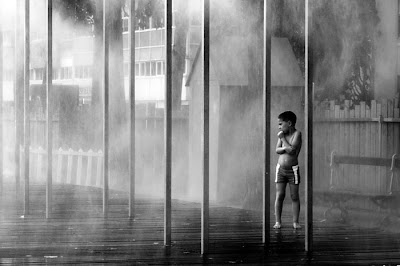 The artificial mist creates a particular mood around the boy and makes him stand out in this graphic environment.
Do you have any advice for people who are new to black and white photography?
I got into b&w photography because I was moved by some photographers’ work. I remember the emotional shock it was for me to discover Sebastiao Salgado’s collection or “reading” Abbas’s Children of Abraham book. So I guess it mainly depends on one's sensitivity. People around me keep asking why I don’t take color pictures and the only thing I can say is that I shoot in b&w because this is the way I feel it, because this is what I find “beautiful.” So, if I were to give advice to someone, with my very small experience, it would be to shoot what you like, because it moves something in you that you want to share. The main key to a strong b&w photo is obviously the light and the shadows it creates, but it is also easy to play with transparencies, reflections, smoke etc. Marc’s rules for b&w are just the most important things you have to bear in mind. :)
 The artificial mist creates a particular mood around the boy and makes him stand out in this graphic environment.
What do you hope to share with others with your photography?
This is a very tricky question actually. I guess I just want to provoke emotions in others the way some photos do for me, either because it tells a story (funny, tragic, informational...) or because the aesthetic or the mood in the picture gets at you. It is mainly about sharing a point of view on one moment in time. The theme that keeps coming back in my photos is the isolation of men in their self-made environment, and my photos are probably my way to show that I care....
Could you comment on a few of your favorite black and white photos?
There are a few of my pictures that are important to me for the moment they represent or for the time I put into them or simply because I was lucky to be there at the right moment.
 "Adieu"
Adieu was taken in New York City. There was a big puddle on the ground and some NYC-style buildings were reflecting in it. It took me a while to figure out what I wanted to do with this and I put my hand over my eyes to protect them from the sun. This is when I realized my hand appeared in the sky, as if coming out from the cloud. It is one of my first water reflection experiences and it has opened up lots of new perspectives to my photographic habits. I didn’t do any processing on it. (1/400 sec f 3.5)
 "Rrrrr"
I like the story in this picture which I find quite funny, this little boy escaping from the roaring man on the poster. This is a photo I had to process bits by bits to get the poster up front bright enough and to get rid of the reflections on it. I also appreciate the general graphic of the composition.
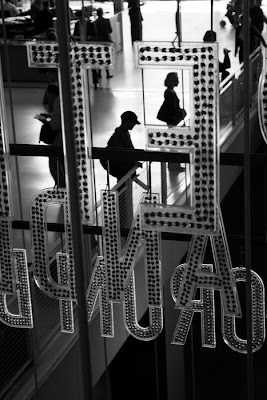 "Grand Ecran"
"Grand Ecran" is an example of human isolation in big cities, everyone in his box, letter ...no communication… and yet a beautiful surrounding. Here I used the red filter to make the letters stand out (as they were red lights) and the light coming from the back helped a lot to darken the silhouettes.
Thanks Marc for having me on take-out photo.
Thank you, Elaine, for sharing your work and insight.
As a side note to my readers, I have to say how impressed I am with both Marcel and Elaine for their willingness to talk about their work and their ability to discuss it so eloquently in a second language. Ever since my interview with Lorrie McClanahan in August I have been wanting to do more interviews, so being able to do two this month has been great.
The month is almost over, but there is still time to post your own black and white work as part of the Monthly Special. [New to Take-out photo? Check out the FAQ page.]
This is a very tricky question actually. I guess I just want to provoke emotions in others the way some photos do for me, either because it tells a story (funny, tragic, informational...) or because the aesthetic or the mood in the picture gets at you. It is mainly about sharing a point of view on one moment in time. The theme that keeps coming back in my photos is the isolation of men in their self-made environment, and my photos are probably my way to show that I care....
Could you comment on a few of your favorite black and white photos?
There are a few of my pictures that are important to me for the moment they represent or for the time I put into them or simply because I was lucky to be there at the right moment.
 "Adieu"
Adieu was taken in New York City. There was a big puddle on the ground and some NYC-style buildings were reflecting in it. It took me a while to figure out what I wanted to do with this and I put my hand over my eyes to protect them from the sun. This is when I realized my hand appeared in the sky, as if coming out from the cloud. It is one of my first water reflection experiences and it has opened up lots of new perspectives to my photographic habits. I didn’t do any processing on it. (1/400 sec f 3.5)
 "Rrrrr"
I like the story in this picture which I find quite funny, this little boy escaping from the roaring man on the poster. This is a photo I had to process bits by bits to get the poster up front bright enough and to get rid of the reflections on it. I also appreciate the general graphic of the composition.
 "Grand Ecran"
"Grand Ecran" is an example of human isolation in big cities, everyone in his box, letter ...no communication… and yet a beautiful surrounding. Here I used the red filter to make the letters stand out (as they were red lights) and the light coming from the back helped a lot to darken the silhouettes.
Thanks Marc for having me on take-out photo.
Thank you, Elaine, for sharing your work and insight.
As a side note to my readers, I have to say how impressed I am with both Marcel and Elaine for their willingness to talk about their work and their ability to discuss it so eloquently in a second language. Ever since my interview with Lorrie McClanahan in August I have been wanting to do more interviews, so being able to do two this month has been great.
The month is almost over, but there is still time to post your own black and white work as part of the Monthly Special. [New to Take-out photo? Check out the FAQ page.]
Tuesday, January 20, 2009
An interview with Marcel S. Pawlowski of the blog Eight Minutes Old

I enjoy reading Marcel's photoblog as much as I enjoy looking at the images he produces. His commentary adds insight and depth into his work. I love learning about the thought behind the image. Even the name of his blog—a reference to the time it takes for light to travel from the sun to your camera's sensor (or film—more on that later)—suggests a unique point of view.
Marcel kindly agreed to answer a few questions and share some of his work with us (and by "share" I mean "show"—please respect his copyright). I hope his insight will inspire you.
Why do you choose to shoot black and white rather than color film?
There are many reasons for this decision. When I started, I used both color and black and white. I gave the film to a lab to develop and print them. Prints were of varying quality and if I wanted a second print, it often looked totally different. The negatives need individual changes in the processing (e.g. developing times), which is seldom done in mass-processing labs. As my skill developed, I became dissatisfied with these results.
I decided to develop the film myself, which is pretty easy for black and white, I can do it in my bathroom. Color processing is much more tricky and the chemicals are more dangerous.
Printing, on the other hand, requires a fully equipped darkroom. Missing enough space, I bought a good scanner. That made is possible to combine the advantages of film and digital photography, and it enables me to present my pictures on the blog.
I could use color film, e.g. slides give pretty nice colors. But black and white has a special feeling to it. I think it is a more honest representation of the scene I took the picture from. To reproduce the true colors is almost impossible. Usually a film / camera chip records three broad band color ranges, red, green and blue. True colors show a much more detailed spectrum.
Colors also increase the possibilities in editing, which on the one hand allows for more artistic freedom, but on the other hand results in more parameters to control and keep in mind, resulting in more work while editing. That might distract me as a photographer. Many photoblogs suffer from too much variety in the presented photos, lacking a personal, recognizable style.
Finally, what might be most important for me is that black and white emphasizes structures and forms. Colors might distract from the graphical character of some photos. Take my Touristscope Series for example: The public pay-telescopes seem to smile at you.
 An example of Marcel's Touristscope Series
 Silhouette of a man in Koblenz
Do you do any post-processing once you have scanned your negatives?
One thing is mandatory: removing dust. There always is some dust on the negatives. That’s truly a disadvantage of film photography.
After that, I tweak the curve a bit, usually to increase the contrast. Some parts might need dodge or burn, too. All in all, I do what I would do in a darkroom, but in a much more convenient manner: The changes can be undone or affect parts of the picture only: I might want to increase the contrast in the sky more than in the other parts. At the PC that’s easy. In a darkroom, where the contrast is mainly determined by the paper you use, that’s a much more tricky task.
And for the web the photos get sharpened a bit.
Do you still look at the different colors around you while you are photographing even though you are shooting in black and white film?
As said before, including colors might result in more parameters and thus work while editing. The same is true when shooting: to find a scenery where all colors fit together is more difficult than to find one where the shades of gray lead to a good black and white photo.
But of course I still look at the colors around me. I enjoy colourful scenes and I’m not sorry I can’t record them with my camera with black and white film loaded. Not everything has to be photographed. We should always be ready to enjoy what we see, enjoy the beauty of the moment.
Even when taking black and white pictures I have to look at the colors in frame. As you described in this month's first post, pictures from digital cameras consist of three color layers. When converting them to black and white, the ratio between the different colors determines the result. The same is true for black and white film photography, but here this can not be done later, in post-processing at the screen. It has to be done when taking the picture, using colored filters. These transmit more of one color than of another.
For example, in the picture with the contrasty sky (taken in Brittany this summer) I attached a dark red filter.
 Landscape in Brittany
It transmits red very well, but blue becomes dark. I have to look at the colors in the scene to determine the effect of the filter. In the example, I saw that the sky is blue and decided to use the red filter to make it look dark. The white clouds were not affected in the same manner, which results in a strongly increased contrast. There was no need to increase the sky contrast in post-processing.
If I take pictures of people, a yellow-green filter is better, just as you described in your post. The filters change the contrast between different colors, so I need to look at them. But I do not depend on them the same way I would if I were shooting color: If in a color image there is one spot in the frame with a bad color, it might distract the viewer and destroy the whole photo. Shooting black and white, I do not have to care for such details.
What are the steps you go through from start to finish when photographing?
I need to feel relaxed and have the time to let myself drift. I can not photograph when I am in a hurry. That’s why I take most pictures while traveling.
First I have to know where I’ll be and what I will take pictures of. This determines my equipment (carry a tripod, which filters, which lenses?), the kind of film I load and what I expect. Most of the time I try to be flexible. Everything can change and I don’t plan my photos in advance at home. The general idea might exist. For example, when I know I’m near the sea, I take my tripod and a grey filter with me. I love to experiment with long time exposures.
It was afternoon and the sun already went down at the beach in Brittany. With a grey filter that blocks 99.9% of the light, the exposure time became 1000 times longer. Using a tripod I took a long time exposure of about 10 seconds. You don’t see anything when the filter is attached, so the focussing has to be done before. The rather short time left some structure in the sea, what I prefer over the mirror-like results of longer exposures. This way, the movement of the water becomes visible.
 A long exposure photo in Brittany
What kinds of subjects are you interested in shooting?
Landscapes, especially near the coast. Urban scenes, you might call them cityscapes, too. This often includes a sky with high contrast and some clouds, at least those are my preferred shots.
I also like street photography a lot, but most of the time I don’t dare to take pictures of others. And I’ve not presented any of these photos on the web, to avoid legal issues.
To sum it up: My subject is reality. The world the way it is. No posed scenes, no artificial light, no manipulation.
Are there any photographers that have inspired your work or continue to?
No, not really. I never understood the concept of idolising someone, so there was no inspiration in a strong sense. There are many photographers whose work I enjoy, most names I forgot (I’m not good at names). This might count as a weak form of inspiration. A legend would be Henri Cartier-Bresson, his work is amazing. One less well known is Dave Beckerman, I follow his blog constantly. In general I try to visit many exhibitions (and photoblogs of cause), where I tend to like black and white photography most. But there are many works in color that can fascinate me just as much.
And for the “really” in “not really”: There is one photographer that did inspired me strongly: My girlfriend Julia. I’m very thankful for that. She actually inspired me to start photography, and still does when we are out to take pictures together. It’s much more fun together than alone.
Is there anything that you want people to learn or gain by looking at your photographs?
In a specific manner: no. As said, my photos are not planned in advance usually. I don’t come up with a message first and then think about how to convey it in a photographic way.
But in a broader sense my photography has a message: The world and reality is beautiful. It needs no hiding behind a transcendental fog, it’s just there in front of us. We only need to take the time to look. Just as there are no simple answers there is no fast-paced beauty.
Subscribe to:
Posts (Atom)